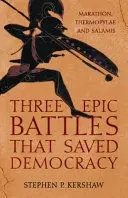
Three Epic Battles That Saved Democracy
Marathon, Thermopylae And Salamis
Stephen P. Kershaw
Praise for the author''s A Brief Guide to the Greek Myths: ''Eminently sane, highly informative'' PAUL CARTLEDGE, BBC History magazine The year 2022 marks 2,500 years since the final defeat of the invasion of Greece by the Persian King Xerxes. This astonishing clash between East and West still has resonances in modern history, and has left us with tales of heroic resistance...
Synopsis
Praise for the author''s A Brief Guide to the Greek Myths: ''Eminently sane, highly informative'' PAUL CARTLEDGE, BBC History magazine The year 2022 marks 2,500 years since the final defeat of the invasion of Greece by the Persian King Xerxes. This astonishing clash between East and West still has resonances in modern history, and has left us with tales of heroic resistance in the face of seemingly hopeless odds. Kershaw makes use of recent archaeological and geological discoveries in this thrilling and timely retelling of the story, originally told by Herodotus, the Father of History. The protagonists are, in Europe, the Greeks, led on land by militaristic, oligarchic Sparta, and on sea by the newly democratic Athens; in Asia, the mighty Persian Empire - powerful, rich, cultured, ethnically diverse, ruled by mighty kings, and encompassing modern Iran, Iraq, Turkey, Syria and Egypt. When the rich, sophisticated, Greek communities of Ionia on the western coast of modern Turkey, rebel from their Persian overlord Darius I, Athens sends ships to help them. Darius crushes the Greeks in a huge sea battle near Miletus, and then invades Greece. Standing alone against the powerful Persian army, the soldiers of Athens'' newly democratic state - a system which they have invented - unexpectedly repel Darius''s forces at Marathon. After their victory, the Athenians strike a rich vein of silver in their state-owned mining district, and decide to spend the windfall on building a fleet of state-of-the-art warships. Persia wants revenge. The next king, Xerxes, assembles a vast multinational force, constructs a bridge of boats across the Hellespont, digs a canal through the Mount Athos peninsula, and bears down on Greece. Trusting in their ''wooden walls'', the Athenians station their ships at Artemisium, where they and the weather prevent the Persians landing forces in the rear of the land forces under the Spartan King Leonidas at the nearby pass of Thermopylae. Xerxes''s assault is a disastrous failure, until a traitor shows him a mountain track that leads behind the Greeks. Leonidas dismisses the Greek troops, but remains in the pass with his 300 Spartan warriors where they are overwhelmed in an heroic last stand. Athens is sacked by the Persians. Democracy is hanging by a thread. But the Athenians convince the Greek allies to fight on in the narrow waters by the island of Salamis (underwater archaeology has revealed the Greek base), where they can exploit local weather conditions to negate their numerical disadvantage. Despite the heroism of the Persian female commander Artemisia, the Persian fleet is destroyed. Xerxes returns to Asia Minor, but still leaves some forces in Greece. In 479 BCE, the Spartans lead a combined Greek army out against the Persians. In a close-run battle near the town of Plataea, the discipline, fighting ability and weaponry of the Greeks prevail. The Persian threat to the Greek mainland is over. Athens forms a successful anti-Persian coalition to drive the Persians from Greek territory, seek reparations, and create security in the future. But this ''alliance'' is gradually converted into an Athenian Empire. The democracy becomes increasingly radical. In this context we see the astonishing flowering of fifth-century BCE Athenian culture - in architecture, drama and philosophy - but also a disastrous war, and defeat, at the hands of Sparta by the end of the century. The book concludes by exploring the ideas that the decisive battles of Thermopylae and Salamis mark the beginnings of Western civilization itself and that Greece remains the bulwark of the West , representing the values of generous and unselfish peace, freedom and democracy in a neighbourhood ravaged by instability and war.
Related Articles






Other books by the author